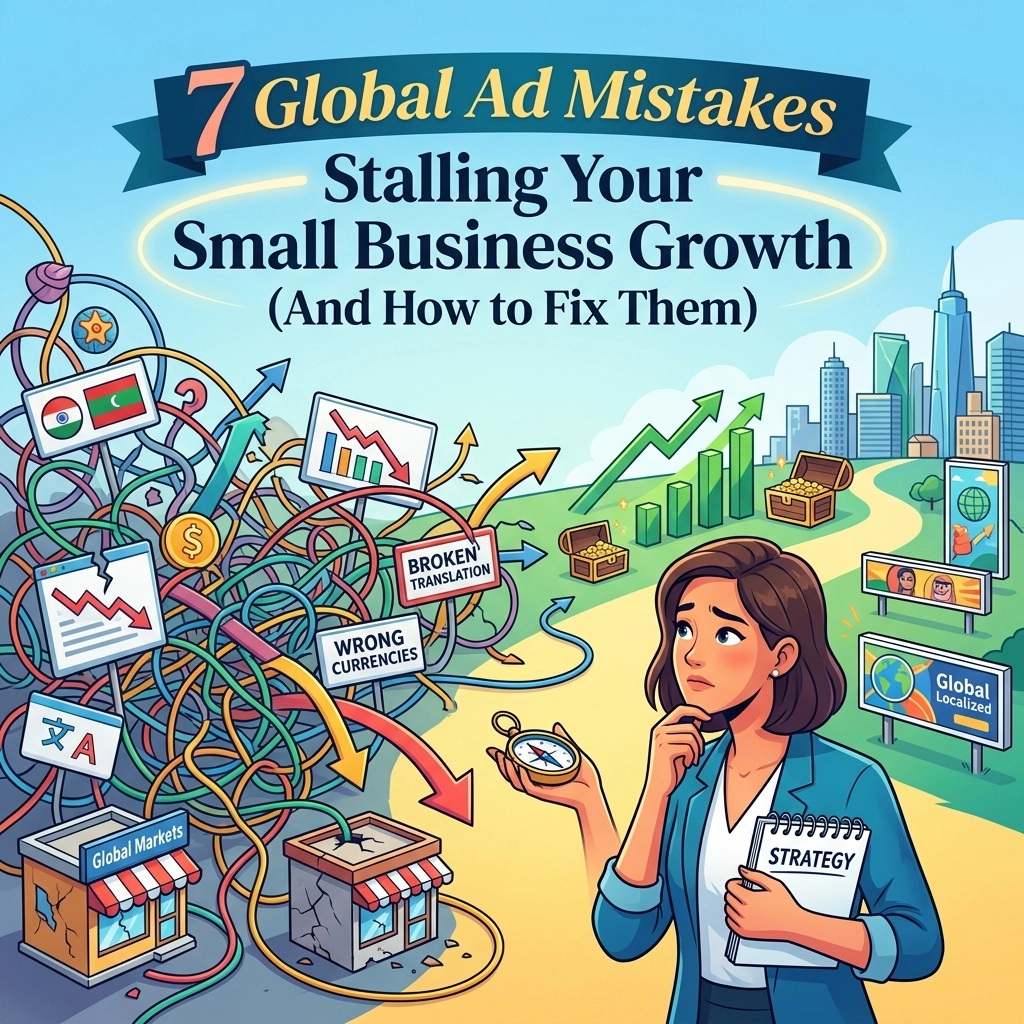
Small businesses often want to grow by selling to other countries. The world is a big place with billions of people. Digital ads make it possible to reach them from your home office. You can set up a campaign and start showing your products in London, Tokyo, or Berlin in minutes.
But many businesses lose money when they try this. They spend their budget and see no sales. This happens because global advertising is not the same as local advertising. What works in your home town might not work in another country. Small mistakes can stop your growth before it even starts.
If you want to win, you must avoid these seven common mistakes. Here is how to fix them and keep your business growing.
1. Using Translation Instead of Localization
Many business owners use tools to translate their ads. They take their English text and turn it into Spanish or French. This is a mistake. Translation is just changing words. Localization is changing the message to fit the culture.
When you just translate, the tone is often wrong. You might use words that sound robotic. You might use slang that does not make sense in another country. This makes customers feel like you do not know them. If they do not feel a connection, they will not buy.
The Solution
Hire a person who speaks the language naturally. They understand the local culture. They know what makes people laugh or what makes them trust a brand. You should also look at your images. A photo that looks good in the US might look strange in the Middle East. Make sure your ads look like they were made for that specific market. You can learn more about how we help with this at International PPC.

2. Ignoring Local Data and Tracking
You cannot grow if you do not know what is happening. Many small businesses run ads but do not track the results. They see that they spent money, but they do not know which ad brought the customer. Research shows that about 37% of marketing budgets are wasted because of poor tracking.
When you go global, tracking gets harder. You have different currencies and different time zones. If you do not set up your data correctly, your reports will be wrong. You might think an ad is failing when it is actually your best one.
The Solution
Set up conversion tracking before you spend a single dollar. Use tools like Google Analytics 4. Make sure you track every step of the customer journey. You need to know when someone clicks an ad, when they add a product to their cart, and when they buy. If you see people leaving at the cart, you know your checkout process is the problem, not your ad. Use data to make choices instead of guessing.
3. Targeting Too Broadly
It is tempting to target a whole country. You might think, "I want to sell to everyone in Brazil." Brazil has over 200 million people. If you try to show ads to everyone, your money will disappear fast. Your message will be too general. It will not grab anyone's attention.
Broad targeting leads to high costs. You end up paying for clicks from people who will never buy. This is a common way small businesses stall their growth. They run out of money before they find their real customers.
The Solution
Start small. Pick a specific city or a specific group of people. Instead of targeting all of Brazil, target tech workers in Sao Paulo. Create an ad that speaks only to them. Once you make money from that small group, you can expand. It is better to be a big deal in a small niche than a nobody in a giant market.

4. High Friction at the Checkout
Imagine a customer in Germany clicks your ad. They love your product. They go to buy it, but the price is in US Dollars. They have to guess the cost in Euros. Then they see that you only accept credit cards they do not use. They will leave your site immediately.
This is called friction. Friction is anything that makes it hard to buy. When you sell globally, friction is everywhere. If you do not fix it, your ads will fail even if they are great.
The Solution
Use dynamic pricing. This shows the price in the customer's local currency automatically. You should also offer local payment methods. In some countries, people prefer bank transfers or apps like Alipay. Make the checkout process fast. Do not ask for too much information. The easier it is to buy, the more money you will make. You can find more tips on managing international sales on the International PPC website.
5. Forgetting Time Zones and Local Holidays
Timing is everything in advertising. If you run your ads on a US schedule, you might be showing ads in the middle of the night in your target country. No one is awake to click them. You are wasting your budget on low-quality traffic.
Local holidays also matter. If you run a "Back to School" sale in August for a country where school starts in February, you look silly. You also miss out on local shopping days like Singles' Day in China or Boxing Day in the UK.
The Solution
Use ad scheduling. Set your ads to run during the peak hours of the country you are targeting. Look at a global calendar. Know the holidays and the shopping seasons for every market. Plan your sales around their life, not yours. This shows that you care about the local market.

6. Poor Mobile Experience
In many parts of the world, people do not own computers. They do everything on their phones. If your website is built for a big screen and loads slowly on a phone, you are in trouble. Global users often have slower internet speeds than people in big US cities.
If your page takes more than three seconds to load, most people will click away. They will go to a competitor who has a faster site. A slow mobile site is a wall between you and your growth.
The Solution
Test your site on a mobile device using a slow connection. Use small image files so they load fast. Make sure your buttons are big and easy to tap with a thumb. Avoid pop-ups that cover the whole screen. A simple, fast site will always beat a fancy, slow one. Mobile optimization is a requirement for global PPC success.
7. Doing Everything Manually
Small business owners often try to do everything themselves. They change bids by hand. They write every ad headline one by one. This works when you have one campaign in one city. It does not work when you have ten campaigns in five countries.
The digital ad world moves too fast for humans to keep up. If a competitor raises their bid at 3 AM, you will lose your spot. If you wait until Monday morning to fix it, you have already lost a weekend of sales.
The Solution
Use AI and automation tools. Google and Meta have powerful AI that can manage your ads for you. They can find the best people to show your ads to. They can change your bids in real-time to get the lowest price. AI lets a small team run a global business. It saves you time so you can focus on making great products.
Managing global ads is a big task. It requires attention to detail and a willingness to learn. Many businesses fail because they treat every country the same way. If you avoid these seven mistakes, you will be ahead of your competition.
Growth comes from being smart with your budget. It comes from respecting the people you are selling to. If you take the time to fix these issues, the world becomes your market. You can find help with your global strategy by visiting International PPC to see how experts handle these challenges.
Start by checking your current ads. Look for translation errors. Check your site speed. Look at your tracking data. Small changes today lead to big growth tomorrow. Stick to the data and stay local in your thinking. That is how a small business wins on a global stage.